
Get Quote
Contact us now to receive a detailed quotation.
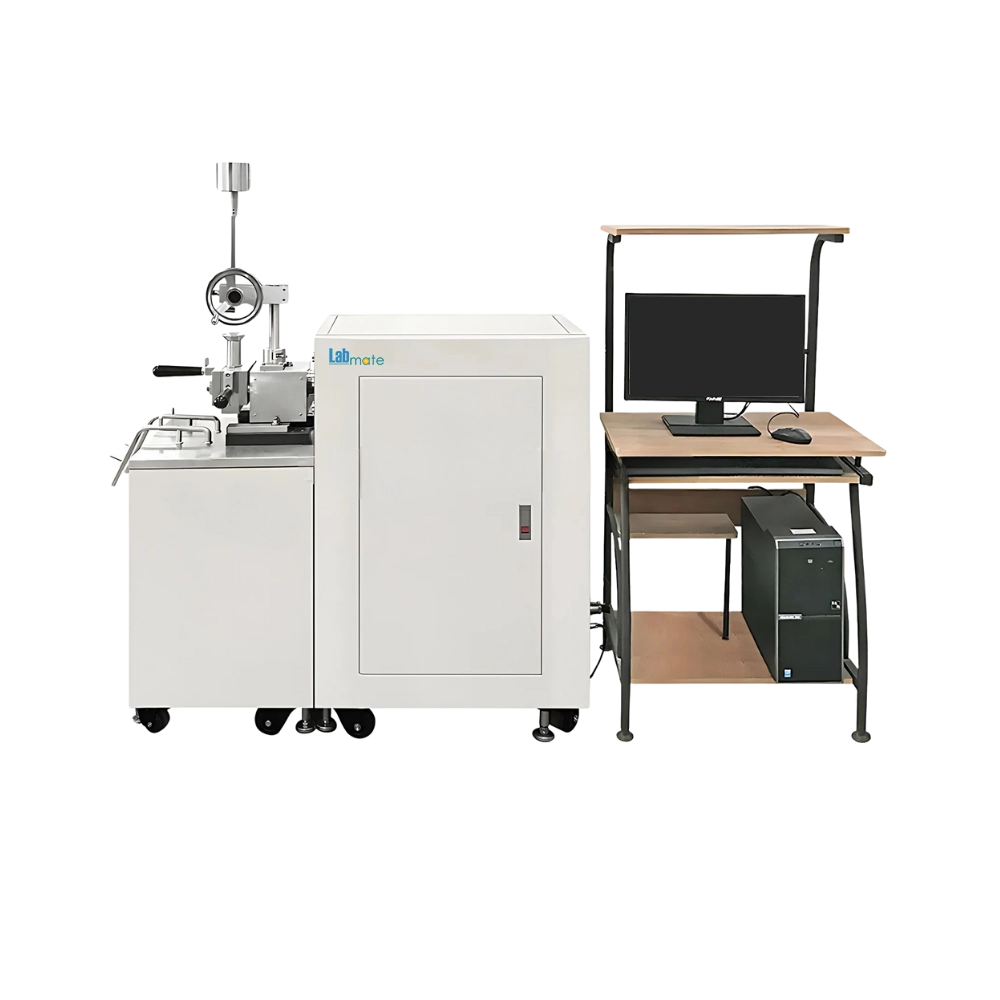
Rheometer LMRHM-A100 with chamber capacity of 60 ml. It analyzes both solids and liquids under varying temperature and shear conditions. Equipped with automatic temperature control for consistent and reliable results. Integrated with advanced software for seamless data analysis and monitoring. Our Rheometer is ideal for research, material science and manufacturing quality control.
Specifications
| Shear Stress | 0.5 Pa to 3 × 10⁴ Pa |
| Shear Rate | 10⁻² 1/s to 6500 1/s |
| Rotation Speed Range | 0.1 to 150 rpm |
| Rotation Speed Deviation | ±0.5% |
| Max Rotation Speed Of Mixing Unit | 250 rpm |
| Torque Range | 0 to 200 Nm |
| Torque Deviation | ±0.1% |
| Max Torque Of Mixing Unit | 200 Nm |
| Melt Pressure Range | 0.1 to 100 MPa |
| Pressure Deviation | ±0.5% |
| Temperature Range | Room temperature to 300°C |
| Temperature Deviation | ±0.5°C |
| Rotor Type | Roller |
| Rotor Speed Ratio | 3:2 |
| Chamber Capacity | 60 ml |
| Dimension | 755 × 470 × 1170 mm |
Pricing
| Product | Price | Unit | Action |
|---|---|---|---|
| Rheometer LMRHM-A100 | $ 47400 | Set of 1 |
Features
Raw material analysis
Formulation optimization
Crosslinking analysis
Durable construction
Applications
Rheometer LMRHM-A100 is employed to analyze viscosity and flow properties of materials. It is essential for research and quality control in industries like polymer, coating, and food processing.
Frequently Asked Questions
1 What is a Rheometer?
A Rheometer is an apparatus designed to measure the rheological properties of substances.
2 What is the difference between a Rheometer and a Viscometer?
A Rheometer is used to measure a wider range of rheological properties such as elasticity and yield stress whereas a Viscometer measures the viscosity of a fluid under a set of conditions.
3 Can Rheometer be used for both liquid and solid materials?
It can be used to study both liquid and solid materials.
4 What is the role of Rheometer in product development?
It helps to optimize material formulations and processing conditions to ensure desired product performance and consistency.
5 How is Rheometer calibrated?
Calibration is done using known standards such as calibration fluids with a known viscosity or standard geometries.
6 What types of materials can be tested using Rheometer?
It can test a variety of materials such as liquids, pastes, gels, suspensions, emulsions, polymers, semi-solids as well as soft solids.
7 Can Rheometer measure temperature-sensitive materials?
It can measure temperature-sensitive materials.
8 What is the role of Rheometer in pharmaceutical applications?
It is used to test the consistency, flowability and stability of formulations like creams, gels or suspensions.
9 Can Rheometer be used in the food industry?
It help the food industry assess the texture, viscosity and flow behavior of products.
10 Can Rheometer be used to evaluate the aging of materials?
It can evaluate the aging of materials by measuring changes in their viscosity and rheological properties over time.